


Table of Contents
Searching for Flood Sources in the Operator’s Network
1. Configuring statistics export from SSG
The following parameter values must be set in the configuration file /etc/dpi/fastdpi.conf:
netflow=12
netflow_dev=vlan200
netflow_timeout=10
netflow_rate_limit=900
netflow_full_collector=10.0.0.0:1500
netflow_passive_timeout=5
netflow_active_timeout=20
netflow_full_collector_type=2
ipfix_reserved=1
where:
netflow=12– statistics collection and export: 8 + 4 = fullnetflow + billnetflow (accounting).netflow_dev=vlan200– wherevlan200is the name of the interface from which statistics will be exported.netflow_timeout=10– export interval in seconds.netflow_rate_limit=900– IPFIX rate limit.netflow_full_collector=10.0.0.0:1500– statistics collector address – specify the correct QoE IP.netflow_passive_timeout=5– inactivity timeout for a session. If no activity is detected during this period, the session is considered finished and its information is exported.netflow_active_timeout=20– interval for reporting long sessions (i.e., long sessions are split into fragments of this duration).netflow_full_collector_type=2– export IPFIX to a TCP collector.ipfix_reserved=1– reserves the required memory to allow enabling/changing IPFIX/Netflow parameters.
After modifying the parameters, restart the service:
service fastdpi restart
2. Searching for a flood source (BotNet)
Searching for subscribers with a high number of flows per second
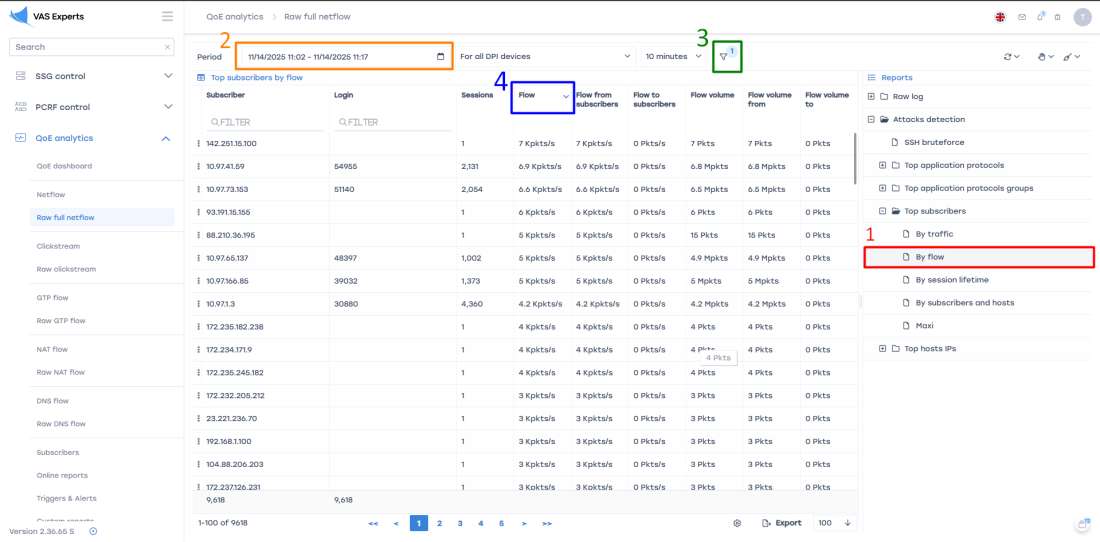
- Open the QoE Analytics report → Raw Full Netflow → Attack detection → Top subscribers → By flow:
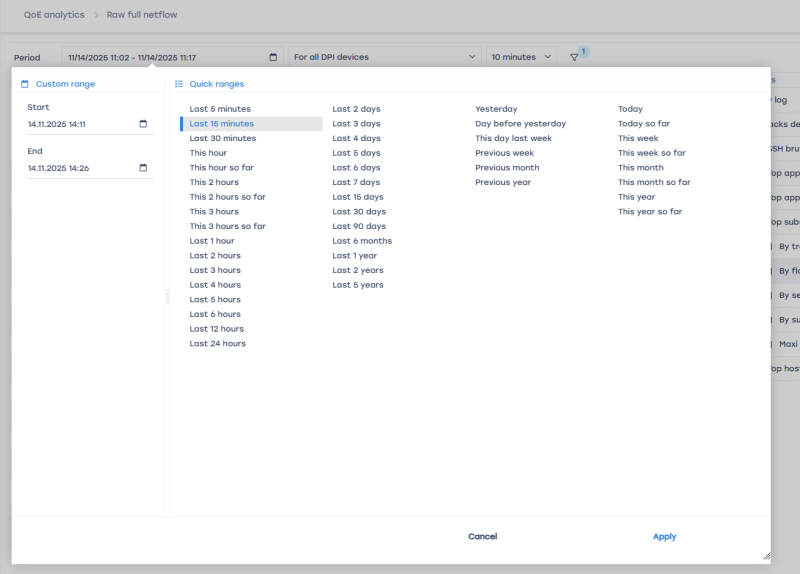
- Set the time range:
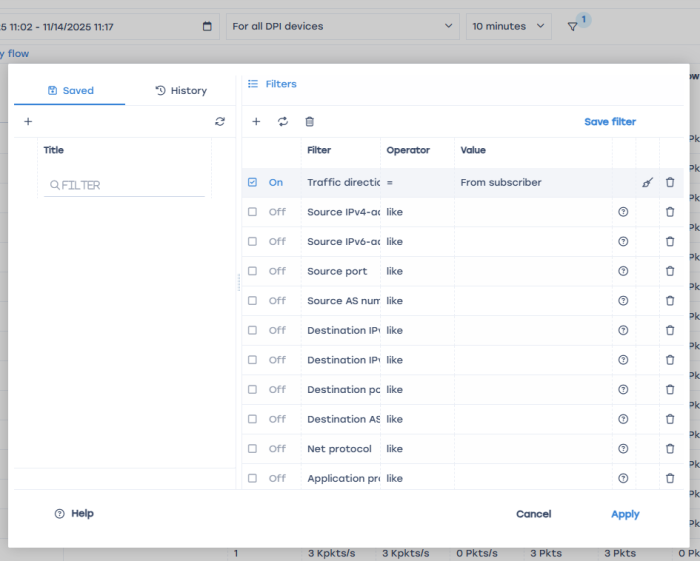
- Add a traffic direction filter – From subscriber:
- Click the Flow column for convenient sorting
The detected subscriber source IP addresses must be added to a local AS (see section 3.1)
Searching for hosts with a high number of flows per second
- Open the QoE Analytics report → Raw Full Netflow → Attack detection → Top host IP addresses → By flow:
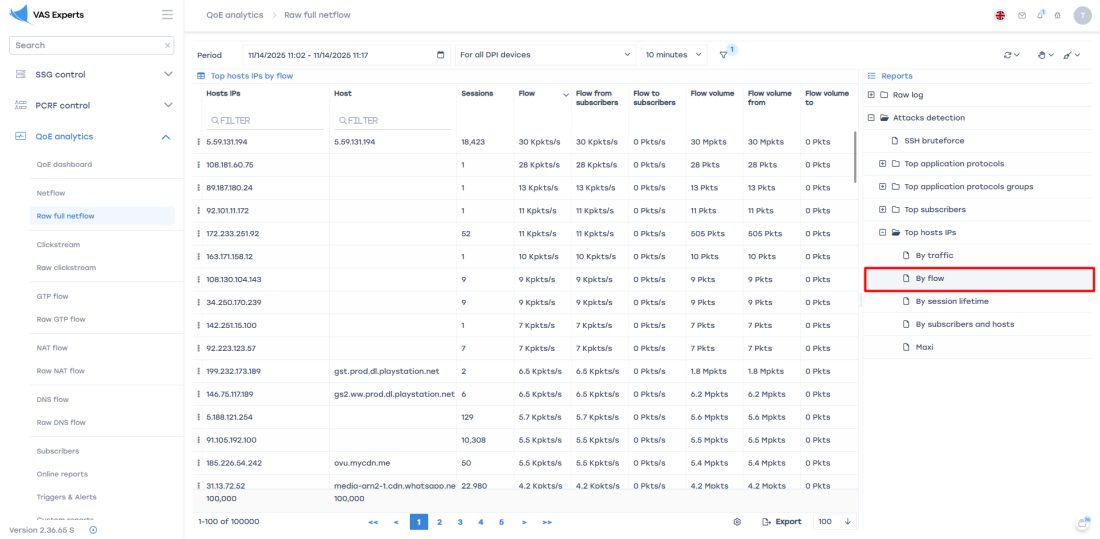
- Set the time range.
- Add a traffic direction filter – From subscriber.
- Click the Flow column for convenient sorting.
The detected host IP addresses must be added to a local AS (see section 3.1)
3. Blocking IPs by assigning them to an autonomous system
Creating a local AS (example for IPv4)
- Create a copy of /etc/dpi/aslocal.bin:
cp /etc/dpi/aslocal.bin /etc/dpi/aslocal.bin.backup
- Convert aslocal.bin to a TXT file using the bin2as utility:
bin2as /etc/dpi/aslocal.bin > /etc/dpi/list.txt
If the aslocal.bin file is missing in /etc/dpi/, create it:
vi /etc/dpi/list.txt
- Add entries to list.txt in the format (CIDR <space> ASN):
10.0.0.1/32 64525
172.16.0.0/12 64525
192.168.0.0/16 64525
Where
64525is the AS that will later need to be blocked. - Convert the CIDR–ASN list from TXT to BIN format using the as2bin utility:
cat /etc/dpi/list.txt | as2bin /etc/dpi/aslocal.bin
- Reload the service (hot parameter):
service fastdpi reload
Assigning a drop rule to the local AS
- Create a copy of the asnum.dscp file:
cp /etc/dpi/asnum.dscp /etc/dpi/asnum.dscp.backup
- Convert asnum.dscp to TXT using the dscp2as utility:
dscp2as /etc/dpi/asnum.dscp > /etc/dpi/asnum.txt
- Add entries in the format ASN <space> drop to the existing records in asnum.txt:
64525 drop
- Convert the TXT file back using the as2dscp utility:
cat /etc/dpi/asnum.txt | as2dscp /etc/dpi/asnum.dscp
- Reload the service (hot parameter):
service fastdpi reload
Was this information helpful?